When No One Can Understand the Rules: Gambling terms, transparency and a growing legal risk



Gambling terms, transparency and a growing legal risk
For years, the complexity of gambling terms and conditions (T&Cs) has been treated as an unfortunate by-product of regulation. Lengthy documents, dense drafting and heavy legal caveats have been accepted as the price of operating in a highly regulated sector. That assumption is now looking increasingly fragile.
Recent court findings against motor finance firms, alongside new draft guidance from the Competition & Markets Authority (CMA) on unfair contract terms, have sharpened the legal focus on transparency, intelligibility and consumer understanding. Together, they point to a clear direction of travel. Where consumers cannot reasonably understand contractual terms, those terms may not stand up in law.
Against that backdrop, our analysis of online gambling T&Cs raises an uncomfortable question for the sector and its regulator alike.
What happens when the rules of play are so complex that most customers cannot realistically grasp them?
Why Intelligibility and Transparency are critical issues
Gambling terms, like other consumer contracts and regulated notices, are governed by the Consumer Rights Act. For gambling specifically, they are also regulated by the Gambling Commission.
The Consumer Rights Act requires that contracts are transparent, and as part of that they need to be ‘intelligible’. In practice this means they need to be able to be understood by consumers, and for the consumer to be able to use that information: to understand their rights and risks, and the rules of the games they play.
The Competition and Markets Authority (the regulator ultimately in charge enforcing the Consumer Rights Act) has recently refreshed its Guidance on Unfair Contract Terms. This has emphasised what firms need to do to ensure that their terms are transparent.
The Guidance places far greater focus on how information is presented, not just what it says. It emphasises that:
- Contracts and notices must be intelligible in practice, not just legally accurate
- Information should be well-structured, easy to navigate and logically ordered
- Transparency is judged by consumer understanding and outcomes, not tick box disclosures
The Gambling Commission’s own Licence Conditions and Codes of Practice reflect the Consumer Rights Act. Section 7 explicitly requires licensees (gambling companies) to ensure that terms and any consumer notices are transparent “within the meaning of the Consumer Rights Act 2015”, and that they are made accessible in a way that “supports readability and understandability”.
Our analysis begins to cast significant doubt on whether many terms actually comply.
Putting gambling terms under the microscope
Using Amplifi’s intelligibility assessment technology, we analysed the T&Cs of 50 online gambling operators currently active in the UK market.
The Amplifi Intelligibility Score is an accurate prediction of whether information can be understood by readers. We’ve tested it with leading academics and regulators, and it’s at the leading edge of intelligibility assessment technology. It looks at not only grammatical and readability issues but also the conceptual complexity of information, and how it's structured.
By applying it to these documents, the aim was not to judge compliance line-by-line, but to test a more fundamental issue: how likely is it that an average adult consumer can understand and use these documents in practice?

The results are stark.
Across the sample, the average intelligibility score was just 33 out of 100. In practical terms, that equates to a level of understanding broadly aligned with undergraduate education or equivalent experience. Only around a third of the UK adult population is likely to be able to fully understand and use the information in the gambling terms.
These are legal document that govern the relationship between the company and the player, and by law have to be understandable to an average consumer.
Some documents performed better than others. The highest-scoring terms reached an intelligibility score of 54, roughly equivalent to a strong GCSE level and accessible to around 60 per cent of adults.
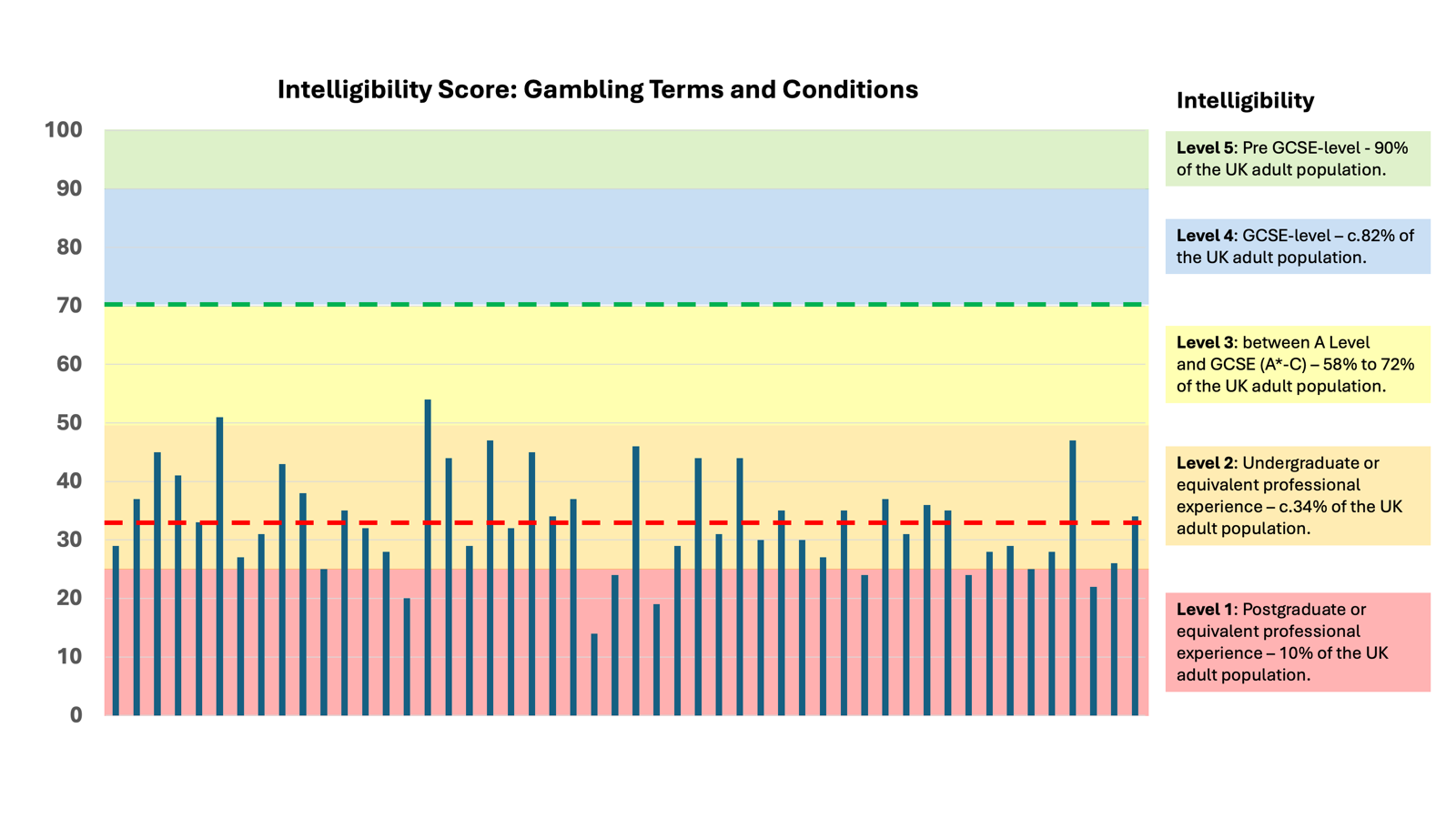
At the other end of the scale, the lowest score was 14. That level of complexity typically reflects a postgraduate level of education or equivalent, and would be fully understood by only about one in ten UK adults.
Firm-by-firm intelligibility assessment results
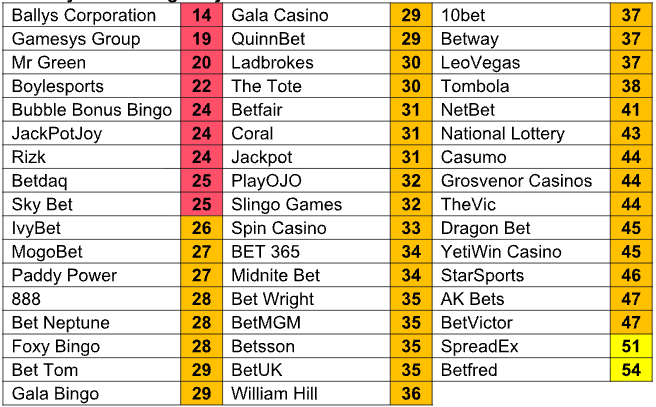
In our wider body of work across multiple sectors, scores this low are extremely rare. In fact, this is the lowest score for a consumer facing document we’ve ever tested (and we’ve tested thousands!).
The complexity we see is not simply a question of style or tone. Intelligibility is the strongest predictor of whether people will actually understand what they are reading. Where intelligibility is low, comprehension, informed decision-making and meaningful consent all fall away with it.
Longer, denser and harder to navigate
The problem is compounded by the length of these documents.

Online gambling terms were, by some distance, the longest documents we have assessed across the sectors we’ve looked at so far. On average, they ran to more than 12,000 words, with the longest approaching 24,000. That is significantly longer than pension policies, legal client care letters, or consumer credit agreements.
Length alone does not make a document unfair. But each additional clause adds cognitive load. Each cross-reference increases the chance that a reader will disengage or misunderstand something material.
Readability scores also reinforce the picture. Using the commonly applied Flesch-Kincaid framework, gambling terms averaged a score of 41, a level typically described as “difficult” or “academic”. Sentences were long, words were syllable-heavy, and best-practice benchmarks for consumer communications were frequently exceeded. Taken together, these factors create documents that may technically disclose information but fail to make it accessible or understandable.
The risk for consumers
Untransparent clauses risk confusion and potential harm for consumers. This in turn risks a legal challenge for firms.
While the Gambling Commission’s guidance has identified general rights to confiscate un-staked deposits or restrict winnings based on vague definitions of ‘irregularities’, many examples of untransparent and unclear rules persist.
“We reserve the right to withhold any amount exceeding the player's original deposit… if the player has breached the terms and conditions.” This relies on a customer being able to read and understand the T&Cs in the first place. Yet most T&Cs we tested would be challenging for even the most savvy of customers to understand. This is a clear imbalance between operator and customer.
Undefined ‘errors’ (whether apparent to the consumer or not), timing issues and technical breaches are all factors buried within the body of 20+ page agreements that gives operators broad powers. These include withholding winnings, confiscating balances or even claiming back previous winnings the customer has already withdrawn.
Yet these rules are not made prominent, aren’t intelligible or clear to the consumer, and are hidden within tens of pages of legalistic and largely impenetrable text. This is a legal challenge waiting to happen – as we’ve recently seen in motor finance agreements.
How does gambling intelligibility compare with other regulated sectors?
One of the most revealing aspects of the analysis emerges when gambling terms are set alongside other complex, highly regulated products.
Credit card agreements and unsecured loan terms, for example, achieved average intelligibility scores above 50. Even pension policies, which describe some of the most complex financial products available to consumers, averaged over 40.
Gambling terms came last.
Gambling terms were found to be less intelligible than any of the other complex regulated documents we tested.
In fact they were significantly less intelligible than even pension policies. Less than a third of all consumers are likely to be able to fully understand them – and when you consider the stakes at hand, that is a considerable risk.

We’ll be taking a deeper dive into these sectors and other products in future articles.
This matters because all of these documents sit within broadly similar legal frameworks. They all face requirements around fairness, transparency and consumer protection.
And the existence of clearer examples elsewhere demonstrates that poor intelligibility is not inevitable. It is a choice, or at least a failure to prioritise clarity.
Why the legal context has changed
Until recently, the risks associated with opaque and legalistic drafting were often viewed as theoretical. That is no longer the case.
The recent court findings against motor finance firms turned, in part, on a lack of transparency around commission arrangements and how key terms were presented to consumers. Even though the Judge accepted that Mr Johnson had not actually read the document, the fact that he would have found it very hard to understand even if he had tried, made it untransparent, and unfair.
The courts were clear: where important information is buried, obscured or framed in a way consumers cannot reasonably understand, firms may not be able to rely on those terms. Transparency and fairness are based on whether the consumer could have understood and applied the information, irrespective of if they had actually read it.
The CMA’s draft guidance on unfair contract terms also places renewed emphasis on intelligibility and real-world understanding, not just formal disclosure. The direction is explicit. Businesses must consider whether consumers can actually read, interpret and use contract terms, not how they are expected to in theory.
For gambling operators, this should ring alarm bells.
A material risk for operators, and for the regulator
If key gambling terms are not intelligible to a majority of customers, they are potentially vulnerable to legal challenge. That includes terms governing bonuses, withdrawals, account restrictions, exclusions and discretionary powers. These are precisely the areas most likely to generate consumer harm and disputes.
The risk is not only financial. Successful challenges would raise uncomfortable questions about past enforcement, redress and oversight. They also place the Gambling Commission in a difficult position. A regulator charged with ensuring fair and open gambling cannot easily ignore evidence that core consumer documents are, in practice, inaccessible to most consumers.
This is not an argument that gambling firms have acted unlawfully. Nor is it a call for simplification at the expense of accuracy. It is a warning that the legal and regulatory bar is rising, and that historic approaches to drafting may no longer be defensible.
The direction of travel is clear
The wider regulatory landscape is shifting towards outcomes, not box-ticking. Transparency is no longer satisfied by volume. Intelligibility has become a testable, measurable expectation.
Our analysis shows that some gambling operators are already closer to meeting that standard than others. Clearer terms are possible within the existing framework. The question is, how long can the rest of the sector afford to wait?
Because if consumers cannot understand the rules, courts are increasingly willing to ask whether those rules should apply at all.
For a chat about how Amplifi can help your organisation to test and improve your own communications, contact us at info@amplified.global

Explore more articles