An objective, evidence-based score for the fairness test your contracts already have to pass: for law firms advising financial services clients, and for the in-house teams that own their terms.
written consumer contract terms must be transparent, which means expressed in plain and intelligible language and legible. A term that fails the transparency test can be assessed for fairness, and an unfair term is not binding on the consumer.
sets out how the CMA reads the transparency and fairness tests. It looks beyond the words to whether a typical consumer would understand what a term means for them in practice.
credit agreements and the information that comes with them carry their own requirements on what borrowers must be told, and how.
for law firms and in-house teams serving financial services, the FCA’s expectations on consumer understanding now sit alongside the contract law test.
since 6 April 2025, the CMA can enforce consumer law directly, including the Consumer Rights Act and the Consumer Credit Act, and fine firms up to 10% of global turnover. Unclear terms are now a direct enforcement risk, not just a litigation risk.
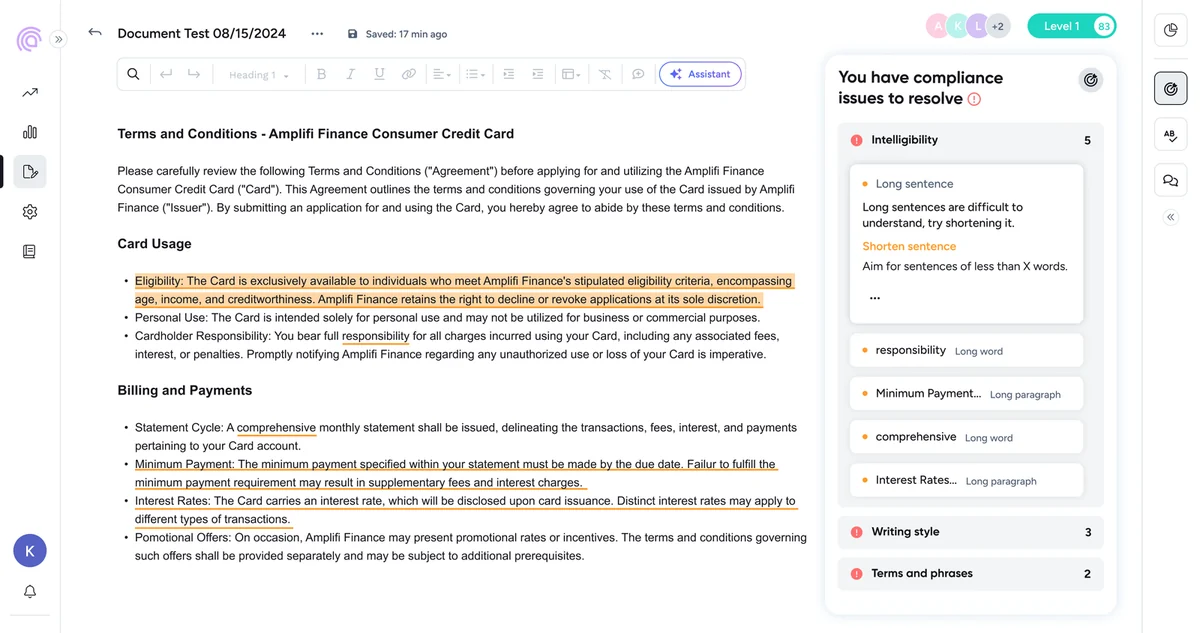
Score clauses and agreements, and see which terms consumers are likely to misread.
Give financial services clients an evidenced view of their terms.
Every score and review is logged, ready for Consumer Duty or a CMA enquiry.

Joint research with the Solicitors Regulation Authority showed legal guidance can be made clearer without losing legal precision.
45 → 67
average intelligibility
the SRA Policy Team used Amplifi to simplify three pieces of guidance, written for consumers and legal professionals: Unbundled Service Guidance, Transparency Guidance and Guidance for Freelance Solicitors.
average intelligibility rose from 45 to 67, an uplift of around 50%. That took estimated reach from 50% to 72% of UK adults, and the reading level from A-Level-to-undergraduate to GCSE.
comprehension testing, eye-tracking with Nottingham University and interviews showed the simplified versions were better understood by consumers and legal professionals alike, without losing definition or meaning.