Redefining Disclosure: How Firms must adapt to the FCA’s modernised Regulatory Framework



Redefining Disclosure: How Firms must adapt to the FCA’s modernised Regulatory Framework
The Financial Conduct Authority’s (FCA) recent regulatory agenda signals a fundamental shift in how firms must communicate with consumers. Moving away from rigid, prescriptive statutory disclosures toward outcome-based frameworks, the regulator has made clarity, transparency, and consumer understanding core regulatory expectations.
Across key consultations, spanning Self-Invested Personal Pensions (SIPPs), General Insurance rules, Consumer Duty updates, and Consumer Investment disclosures, the message is clear. Technical compliance alone no longer protects firms from legal or regulatory jeopardy.
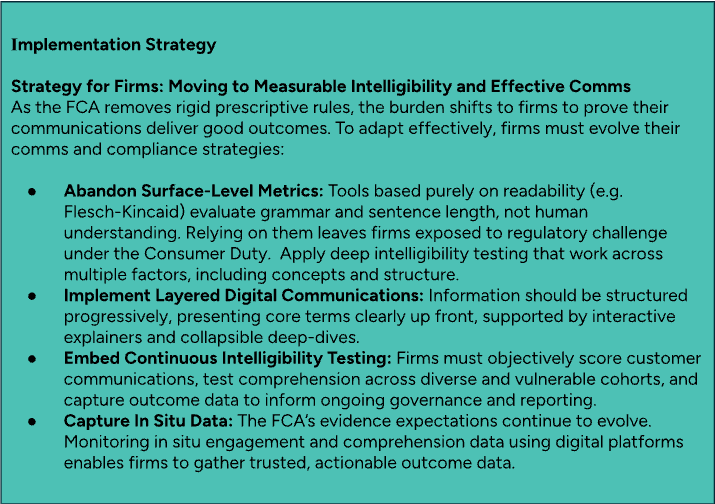
To survive and thrive under this modern disclosure regime, firms are expected to communicate in a more layered, digital-first and effective way. And to support this fresh approach, they must move beyond outdated testing methods such as readability measures and focus groups. Instead, they will need to embrace a 360-degree approach that tests how intelligible their comms are - looking at linguistically clear, how well structured, navigable and accessible their comms are - and provide evidence of how this supports positive consumer outcomes.
Flat PDFs and lengthy 2D agreements will not cut the regulatory mustard.
A Summer of Consultation
As usual, the FCA kept the regulatory folk in the industry busy over the summer, by releasing a wave of consultations. Individually they are interesting, but together they show us a real shift for how customer disclosures will be regulated.
A number of these were focused on changing how firms communicate.
CP26/20 Adapting Rules for Self-Invested Personal Pensions (SIPPs)
- Key Changes: The FCA’s CP26/20 introduces explicit Handbook due diligence standards and a new Pension Scheme Money and Assets (PSM&A) regime to protect consumers from fraudulent or implausible investments and operator failures.
- Impact on Understanding & Vulnerability: Complex pension structures, technical terms, and third-party arrangements present severe cognitive burdens. When disclosures are opaque, consumers are vulnerable to severe long-term financial detriment.
- Amplified Global Position: As outlined in our responses regarding long-term financial decision-making, information must not merely inform. It must empower. SIPP providers must ensure that due diligence summary disclosures and fee/risk structures are presented in an accessible, layered format. Compliance requires firms to ensure their disclosures must clearly communicate the full range of investor choices.
CP26/22 Simplifying the Insurance Rules (ICOBS)
- Key Changes: CP26/22 removes duplicative EU-derived disclosures (e.g. postal addresses and complex conflict-of-interest statements) under ICOBS 4 and establishes digital communications as the default channel while retaining accessible paper options. It also simplifies the advice framework by aligning rules strictly to ‘personal recommendations’.
- Impact on Understanding & Vulnerability: Removing disclosure clutter is a positive step toward reducing cognitive overload. However, shifting to digital-by-default risks creating an intelligibility gap if journeys are simply PDF re-uploads rather than optimised digital experiences.
- Amplified Global Position: Aligning with our response to the CMA’s Guidance on on Unfair Contract Terms and our Consumer Credit Act submissions, Amplified Global maintains that readability does not equal intelligibility. Merely converting PDFs to mobile screens does not guarantee comprehension. Firms must leverage interactive digital layering to present information dynamically, giving consumers the ability to navigate complex policies while providing firms with the data needed to monitor understanding outcomes.
CP26/23 Review of the Consumer Duty Framework
- Key Changes: CP26/23 refines the Consumer Duty regime after three years of implementation, providing targeted guidance on proportionality, distribution chains, and co-manufacturing models.
- Impact on Understanding & Vulnerability: The consultation highlights that many firms have engaged in ‘defensive compliance’, producing vast volumes of dense legal disclosures out of fear of regulatory action. It accepts that this ultimately harms consumer understanding. Vulnerable groups are disproportionately impacted by complex, uncoordinated disclosures.
- Amplified Global Position: In line with our previous submissions on targeted support (CP25/17) and AI implementation, we argue that the Consumer Duty’s Consumer Understanding Outcome demands defensible evidence of comprehension. Firms cannot rely on self-reported clarity or basic recall tests. Compliance requires structured, multi-level comprehension testing that measures whether consumers can infer consequences, weigh trade-offs, and act on information effectively.
CP26/24 Simplifying Consumer Investment Disclosures
- Key Changes: CP26/24 seeks to streamline retail investment disclosures, reducing information overload in pre-sale and point-of-sale customer journeys.
- Impact on Understanding & Vulnerability: Retail investments carry inherent risks (such as capital loss and complex fee structures) that consumers frequently misunderstand when buried in standard key features documents.
- Amplified Global Position: Drawing from our joint research with TISA and Nottingham University, Amplified Global advocates replacing static disclosure packages with frictionless, layered digital journeys. Our findings prove that interactive explanations, visual breakdowns, and contextual risk warnings significantly increase comprehension and investment confidence, particularly among non-expert and vulnerable consumers.
The New Regulatory Reality
Collectively these consultations show some clear policy transitions:
- From firm-led to consumer-led disclosure.
- From prescribed format and information towards greater freedom aligned with a requirement to provide strong evidence of outcomes.
- A move to digital-first disclosure.
The FCA’s ongoing modernization of disclosure rules represents a crucial watershed moment for retail financial services. The transition away from rigid statutory paperwork toward dynamic, digital-first frameworks creates an extraordinary opportunity for firms to eliminate information clutter, lower cognitive burden, and build genuine trust through frictionless consumer journeys.
However, this new flexibility comes with a vital regulatory imperative: firms cannot satisfy the Consumer Duty by simply migrating static, paper-based PDFs onto modern digital screens.
The regulator expects that organisations to take full ownership of consumer understanding by providing empirical, outcome-based evidence of comprehension. This will ensure that modern disclosures do not merely present information but truly empower every consumer to make informed financial decisions.

Explore more articles