Plausible isn't provable: the compliance risk of simplifying regulated communications with LLMs (including MS Copilot)



Simplification is a risk-control problem, not a writing problem
General-purpose LLMs such as Microsoft Copilot can rewrite a dense credit card agreement into fluent plain English in seconds. Copilot is especially tempting: it sits inside Word and is already licensed across most financial services and law firms.
But regulators will not ask whether a firm produced simpler-sounding language. They will ask whether it reduced the risk of customers misunderstanding, without creating new legal risk, and whether it can prove it.
This article brings together Amplifi's research on how MS Copilot and other LLMs perform on that task, and why their design creates exposure under the FCA's Consumer Duty and the CMA's unfair contract terms guidance (CMA37).
In short: MS Copilot is built to generate language. Amplifi is built to measure and reduce intelligibility risk.
The regulatory standard is intelligibility, and it must be evidenced
The FCA and the CMA now expect the same thing: firms must show that customers can understand and apply what they are told, not just that it was disclosed.
FCA Consumer Duty. The consumer understanding outcome (PRIN 2A.5) requires communications that equip customers to make informed decisions, and firms must test and evidence that they work. The standard is intelligibility (how easily information is understood and applied), not readability (how easily text is read), which is what general-purpose LLMs can optimise for.
CMA37. The CMA reissued its unfair contract terms guidance on 22 July 2026. Terms must be transparent: plain, intelligible and legible, with onerous terms given real prominence. Since April 2025 the CMA can also find a term unfair and fine a firm up to 10% of global turnover without going to court. The FCA enforces unfair terms law too, so one clause can breach both regimes.
Simplifying terms and notices is therefore a compliance activity. Edits that weaken a qualifier or drop a disclosure create exactly the risks both regulators target, and firms need objective, repeatable evidence that their communications are intelligible.
LLMs are probabilistic, so their outputs create a probability of risk
LLMs, MS Copilot included, do not apply fixed rules. They predict the next most likely word. That makes them flexible, but it also means they can hallucinate, or soften legal nuance when another phrasing seems more statistically plausible.
Same document, same prompt, different answers
We asked ChatGPT (GPT-5.3) and Gemini (3 Flash) for an "Amplifi Intelligibility Score" for the publicly available Jaja credit card agreement, using an identical prompt:
- ChatGPT, asked three times, gave a different score each time.
- Gemini estimated 71–90.
- The agreement's actual intelligibility (Amplifi) score is 55. Neither model produced it once.
- Amplifi's Cognitive Risk Engine™, run on three different dates, created a consistent score and identical report every time.
Why this is a compliance risk
An inflated score is a false positive: the firm believes a communication is intelligible when it causes confusion. Under the Consumer Duty that is foreseeable harm; under CMA37 it is a firm wrongly believing its terms are transparent. An inconsistent score cannot be evidence at all, because there is no stable baseline or measured improvement to show a regulator.
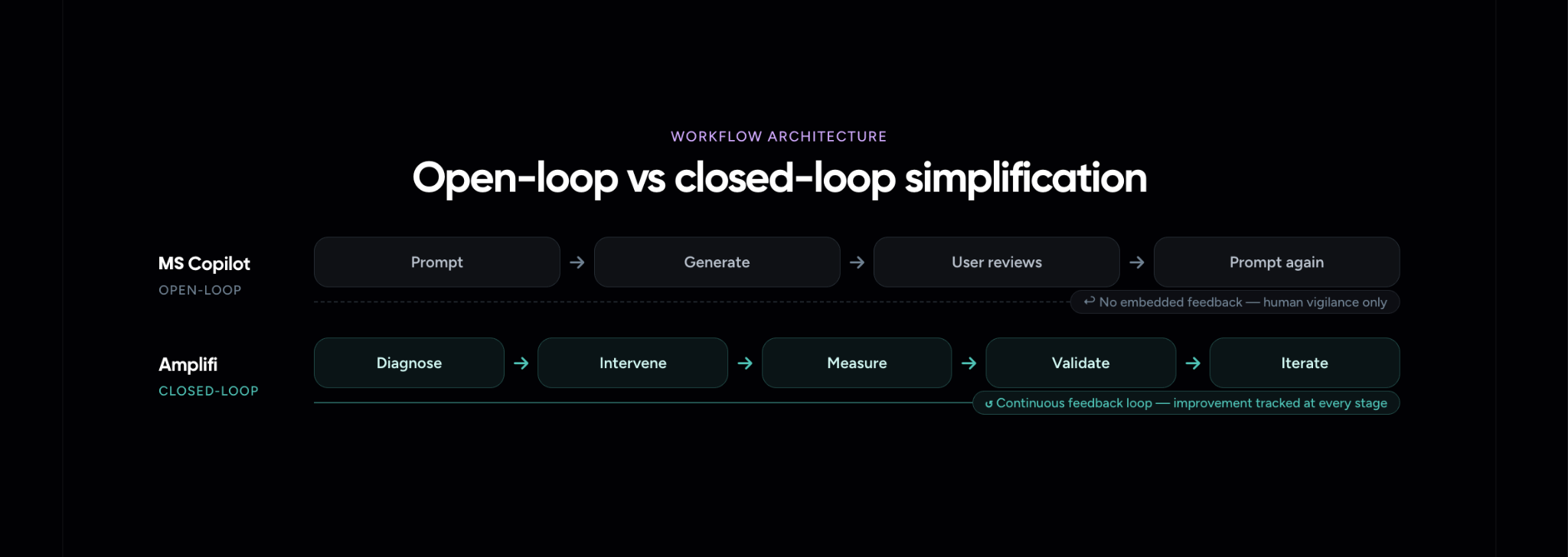
Amplifi's scoring is deterministic: the same input always produces the same output, through fixed, verifiable rules. It pinpoints which clauses are complex and why. Intelligibility-trained AI then supports editing, so the generative part helps write and the deterministic part decides whether the writing worked.
MS Copilot's limits are architectural, not cosmetic
MS Copilot often writes very well. The problem is that good language generation is not the same as reliably completing a regulated task.
Simplification is a bounded task
Regulated simplification must reduce intelligibility risk while preserving legal meaning and required disclosures, and add no new ambiguity. That needs a clear task definition, controlled execution, measurable success criteria and verifiable completion. MS Copilot provides none of these natively; Amplifi is built around all four.
Prompts are not controls
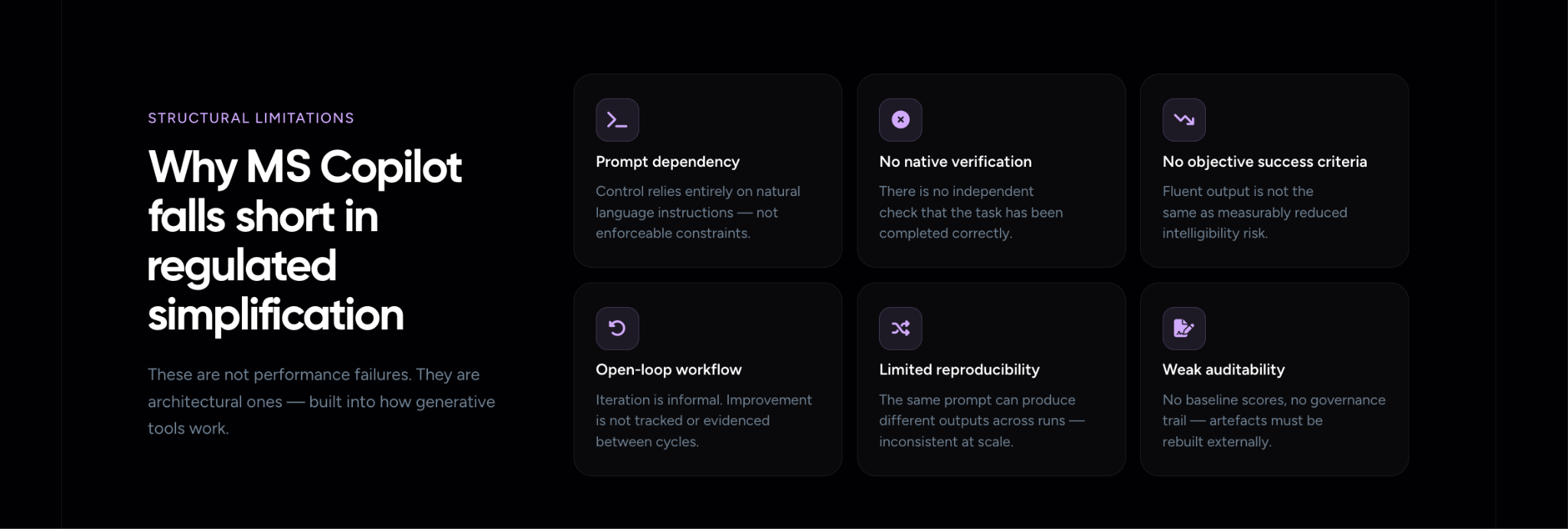
In MS Copilot, the whole task has to be packed into a prompt. But prompts are interpreted probabilistically, so they may be followed fully, partly or not at all. Reliability tends to fall as constraints are added, and results depend on the individual's prompting skill rather than a consistent process.
No task understanding, no verification
MS Copilot has no representation of what "success" means in regulatory terms. Predictable failures follow: editing beyond scope, softening qualifiers, oversimplifying by omission, and inconsistent changes across sections. It also cannot independently confirm that intelligibility improved, so verification is quietly handed to a human reviewer.
Reproducibility and auditability
The same prompt can give different outputs on different runs, and MS Copilot keeps no native governance trail. Amplifi provides baseline and final scores, visible complexity drivers, and an audit trail of checks, edits and approvals.
Conclusion: use MS Copilot to draft, not to prove
MS Copilot is a useful drafting aid for first-pass rewrites, summaries and FAQs. But it is not a system of control or validation, and neither its output nor its own assessment of that output is evidence of compliance. For legal, risk and compliance teams working under the Consumer Duty and a newly enforceable CMA37, a best guess is not good enough.
Amplifi diagnoses where comprehension risk sits, guides targeted simplification, measures the result with a deterministic score, and records the evidence regulators expect.
MS Copilot is built to generate language. Amplifi is built to manage and reduce intelligibility risk.

Explore more articles