Response to the CMA Consultation on Draft Guidance: Unfair Contract Terms


.jpg)
Q1. Do you have any comments on the new structure and presentation of the Draft Guidance?
The revised structure represents a clear improvement in terms of usability. Introducing core concepts such as transparency earlier in the document helps businesses understand the framework before engaging with more detailed legal discussion and examples. This is likely to help non-specialist users navigate the guidance more effectively.
From our perspective, the most positive aspect of the restructuring is that it places greater emphasis on transparency as a mechanism for enabling consumers to make informed choices, and positions intelligibility as a core element. This aligns with the intent of the transparency requirement under the Consumer Rights Act 2015 and reflects broader regulatory developments that increasingly focus on consumer understanding rather than formal compliance alone.
However, the revised structure could be strengthened further by making a clear the links between:
- the legal test for transparency
- the practical objective of ensuring consumers can understand the implications of a term before agreeing to it
- the steps a firm may need to carry out to ensure they are confident communications are likely to be understood and inform a consumer’s decision in practice – e.g. a) testing intelligibility prior to sharing regulatory and contractual information, and b) by monitoring consumer outcomes.
In addition, the guidance could benefit from structural features that help translate legal principles into operational practice. For example:
- short “practical compliance” summaries at the end of sections.
- checklists setting out the factors the CMA is likely to consider when assessing intelligibility. and
- clearer signposting between transparency, fairness, and prominence requirements.
These additions would help businesses move from understanding the legal rule to implementing it effectively.
Q2. Does the tone strike the right balance between comprehensive explanation of the legal provisions and readability for non-specialist users?
The tone of the Draft Guidance generally strikes a reasonable balance between legal accuracy and accessibility. Compared with earlier guidance, the explanations of transparency and fairness are clearer and more practical.
However, we would very strongly encourage the CMA to place a much stronger emphasis on the distinction between readability and intelligibility.
In fact, to reference readability in the way used in this question is itsefl misleading. Conflating readability and being understandable (intelligibility) in any way could cause firms to believe they are compliant, when in reality they fall short of the requirements under the Consumer Rights Act.
We will address this issue in two ways: a) in terms of the accessibility and intelligibility of the guidance document (what you refer to here as ‘readability’), and b) the need for CMA to make the distinction between readability and intelligibility clearer in the matter of the guidance.
In terms of how non-specialist readers might engage with and understand this guidance, the use of clear structure, unpacking the legal concepts using simple language, and providing practical, simple examples will help many non-specialists to comprehend the guidance. In this sense it is intelligible.
there are some areas where the intelligibility and accessibility of the guidance could be improved further:
- Length and density of explanation: Some sections retain a highly legalistic tone that may make it difficult for non-specialist users to identify the key compliance expectations.
- Practical framing: In places, the guidance explains the legal rule but could go further in explaining what businesses should do in practice to meet the standard.
- Consumer understanding: The discussion of transparency would benefit from clearer acknowledgement that compliance ultimately depends on whether consumers can realistically understand the effects of a term.
Our tool (used by both regulators and businesses across both financial services and legal) is a way to test and simplify legal and regulated documents. We used it to score the guidance note, and the intelligibility score was 32. This is reflective of a complex document that is likely to be fully understood to around a third of the UK adult population.
The guidance will have a glass ceiling to this score, given the range of technical, conceptually complex and industry terminology you are required to use. However, we can see areas where significant improvements could be made outside of these areas (e.g. complex sentence structure and providing clearer and simpler explanations of those terms).
To help you understand these areas of complexity and where improvements might be made, I have attached a copy of the document intelligibility report produced by Amplifi.
Please let me know if you would like to discuss this and our assessment findings in more detail.
Intelligibility vs Readability
It is our experience that many firms across different sectors currently conflate ‘readability’ with ‘intelligibility’.
This is for a few reasons:
- Until relatively recently, the term readability was used interchangeably with intelligibility. However, since a number of court cases in 2015/16 in the European Court of Justice, intelligibility has been much more clearly defined from a legal perspective.
- Readability measures are objective and have reflected the art of the possible until relatively recently, and the emergence of tools like Amplifi. However, readability is focused on grammar, sentence length, and word length. A great deal of research has shown very clearly that readability measures alone do not reflect intelligibility and are often a poor indicator of understanding outcomes.
- There are many established writing tools on the market that include readability measures. So firms have used the tools they already use to create content to provide a means of testing it. But by relying on these limited tools that were never designed to test intelligibility or understanding, they leave themselves open to legal challenge. M any documents that achieve marks such as the Crystal Mark believe this provides evidence of compliance with the Consumer Rights Act. But this is far from the truth. Short sentences, properly punctuated with many short words can still be very hard for many consumers to understand.
Readability does not = intelligibility.
Yet businesses and regulators continue to interpret intelligibility primarily in terms of readability. While improving readability is a helpful step, it does not necessarily ensure that consumers understand the practical meaning or consequences of a term.
In practice, a term may appear readable but still fail to communicate its real implications. For example, consumers may not understand:
- the financial consequences of a pricing clause.
- how a renewal mechanism operates in practice. or
- the circumstances in which a business may change the terms of a contract.
The guidance would therefore benefit from more explicit acknowledgement that transparency is ultimately about whether consumers can realistically understand how a term affects them, rather than whether the wording simply appears clear. And ultimately that readability is not a measure of intelligibility.
Providing examples that demonstrate this distinction would significantly improve the usefulness of the guidance for non-specialist users.
Q3. Do you have any comments on the usefulness, relevance and clarity of the illustrative examples?
The examples given are one of the most valuable elements of the Draft Guidance. They help translate legal principles into concrete situations that businesses can recognise.
In particular, examples that demonstrate how terms may fail transparency are helpful in illustrating the types of issues that may arise in practice. For example, due to:
- lack of prominence.
- complex wording. or
- hidden practical consequences.
However, the examples could be strengthened in two ways.
First, many examples would benefit from clearer explanations of why a term is likely to be problematic. Linking the examples more explicitly to the transparency factors the CMA considers (for example intelligibility, prominence and the ability to assess practical consequences) would help businesses understand the underlying reasoning.
Second, it would be particularly valuable for the guidance to show how problematic terms could be re-written or presented differently in order to improve consumer understanding. Demonstrating how terms can be made genuinely intelligible would provide businesses with clearer direction on how to comply.
Emphasis on structure, connectivity, navigation and prominence
We particularly welcome the emphasis placed on ensuring that a consumer is able to easily navigate the information, find the key information they need, and connect information across the various sources of information they may be presented with as part of agreeing to a product or service.
Our research into product disclosures, particularly in financial services, has brought failures of firms to address this issue to our attention, and the challenges this poses for consumers.
For example, we looked at the disclosures that form the terms and conditions, and the associated information provided to enable a customer to understand the information, it’s importance and implications. In this example it features a product from Trading 212, but this is not atypical, and is broadly representative of issues we found across a range of contracts and firms.
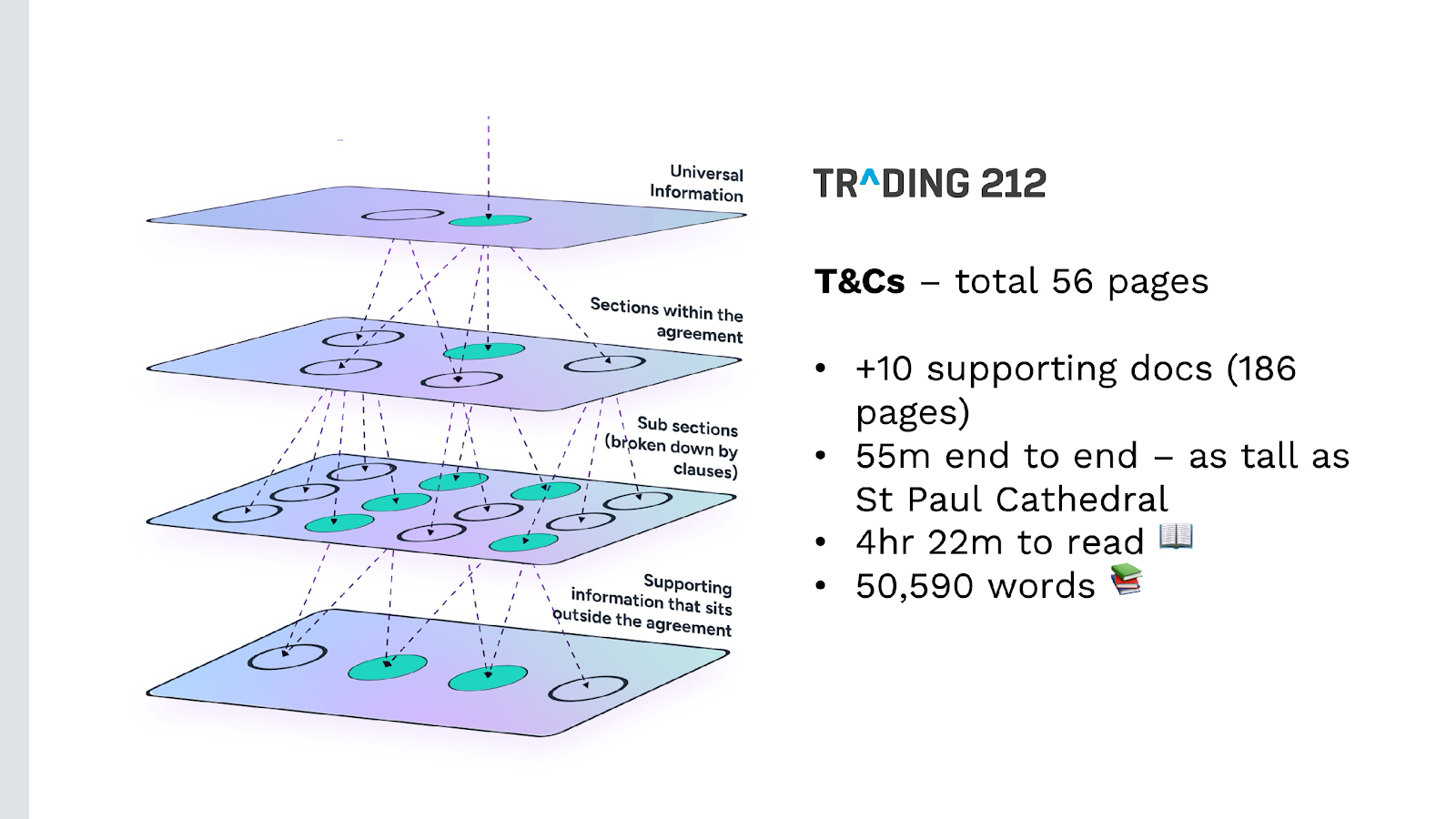
In this case, there were more than 10 documents a consumer would need to navigate and read, with little information to help them to connect the information across these documents. The information was vast, totalling over 186 pages in all, spanning over 50,000 words. These documents were tested using our intelligibility assessment tool, and found to be complex, and many of them unintelligible to anyone but the most experienced reader.
Yet this is not uncommon, despite the existing rules around intelligibility, transparency, and even the FCA’s Consumer Duty and it’s requirement for positive consumer understanding outcomes.
Acting on cases that breach these requirements and emphasising the need to provide better structure and connectivity of information and examples of how this can be achieved will be a big step forward.
Emphasis should be given to examples, and in particular to the opportunity that modern, digital presentation of information can offer. We have found through our research that layered, digital presentation can improve both engagement and understanding outcomes considerably. This research was carried out with both Nottingham University and Cardiff University.
We would be happy to share further details with CMA if required (we have already shared an overview of the research and findings with Andrew Hadley at CMA in September 2025).
Q4. Are there areas where additional examples could be added?
We refer back to our previous comments, particularly around providing examples that illustrate the difference between intelligibility and readability.
Additional examples would be helpful in areas where consumer contract structures have evolved since the publication of the current guidance in 2015.
Another area where additional examples and explanation would be helpful is regarding the digital presentation of terms.
Increasingly, contractual terms can be presented through layered digital interfaces (such as expandable sections, hyperlinks, or mobile-first interfaces). Examples illustrating how prominence and intelligibility should be achieved in these environments would help businesses interpret the transparency requirement in modern contexts.
Q5. Is there anything in the current CMA37 that should be retained but has not been included?
One particularly important feature of the current guidance is the clear statement that transparency and fairness are separate legal requirements.
Under the Consumer Rights Act 2015:
- a term may fail the transparency requirement even if it is not inherently unfair. and
- where a term is ambiguous due to lack of transparency, the interpretation most favourable to the consumer applies.
Maintaining this distinction is important for compliance. Businesses sometimes focus primarily on whether a term is substantively fair, without recognising that a term may still breach the transparency requirement if consumers cannot clearly understand it.
Ensuring this distinction remains explicit in the revised guidance would support clearer compliance.
Q6. Do you have any comments on the usefulness and clarity of the technical note?
The technical note provides useful legal context and helps explain how the guidance relates to case law and legal interpretation.
However, its practical usefulness could be enhanced by making clearer connections between the legal analysis and the operational implications for businesses.
In particular, the technical note could benefit from:
- short summaries highlighting the practical implications of the legal principles discussed,
- clearer explanation of how courts assess intelligibility and foreseeability, and
- examples that demonstrate how legal principles translate into the drafting and presentation of terms.
This would help ensure that the technical material supports practical implementation rather than remaining purely explanatory.
Q7. Would you prefer the technical note to be incorporated in the Draft Guidance or remain separate?
It is preferable for the technical note to remain separate from the main guidance.
Maintaining this separation allows the main document to remain accessible to non-specialist users, while still providing a deeper level of legal explanation for those who require it.
A separate technical note also allows the CMA to update legal analysis more easily as case law evolves, without needing to revise the main guidance document.
Clear cross-referencing between the two documents would help ensure that readers can easily navigate between the practical guidance and the underlying legal analysis.
Q8. Do you have any other comments?
We have no further comments.
If you would like further information concerning anything included in our response, please contact us.
Ewan Willars
Regulatory Lead, Amplified Global

Explore more articles